
Web Articles System Review Support, Others, Business Efficiency
2026/05/22
HUE and HULFT Square Collaboration Solution Launched|Achieving a Data Collaboration Infrastructure that is Highly Resilient to Change
We are pleased to announce that "HUE", ERP for major enterprises, has started to provide a solution for integration with "HULFT Square", an iPaaS from Japan. The existence of countless integration add-ons and handwritten programs that have been spliced in "on the outside" to connect with peripheral systems has become a serious "IT debt" that leads to black boxing in many companies. This article introduces the issues and specific benefits that a new federated solution will solve.
Table of Contents
1. HUE, an ERP for major Japanese companies, and HULFT Square, an iPaaS
In recent years, the number of internal systems has increased due to the spread of SaaS, and with it, the number of integrations between services has also increased to an unprecedented level. However, the need to respond individually to the different specifications for each destination not only increases the difficulty of implementation, but also places an unprecedented burden on IT departments due to the lack of specialized human resources.
In order to solve these issues, Works Applications, which develops the cloud ERP "HUE" for major enterprises, has started offering a collaborative application with HULFT Square, a cloud-based data integration platform (iPaaS) from Saison Technology, Inc. (Saison Technology), a Japanese cloud data integration platform (iPaaS) provided by Saison Technology, Inc.
This solution is, This solution supports the modernization of complex data collaboration networks and the renewal of "loosely coupled" IT architectures that are resistant to future changes. This solution is designed to modernize complex data federation networks and support renewal to a "loosely coupled" IT architecture that is resistant to future changes.
2."Data Linkage" issues to be solved by HUE × HULFT Square
Many companies have been responding to the rapid increase in collaboration needs associated with the rise of SaaS by "individual development" on a case-by-case basis, and the reality of their IT infrastructure is beginning to diverge significantly from the current business speed and management level requirements. This divergence is becoming apparent as a "negative legacy" for companies in the following two specific aspects.
- Increasingly diverse linkage methods and development variations
In the past, simple methods such as file transfers were the mainstream, but today there is an explosion of variations in linkage, including API linkage and authentication methods that differ from SaaS to SaaS, and via cloud storage. In response to this, the method of building a separate integration program outside of the ERP for each case is reasonable in the short term. However, programs written in different ways for each connection point will be created, and the entire IT infrastructure will become more complex, The entire IT infrastructure becomes more complex, leading to a "lack of speed" that makes it impossible to respond immediately to business changes. This is causing a "lack of speed" that cannot respond immediately to business changes.
- Gentrification of operation and maintenance and limitation of manpower
Many of these individually developed programs are dependent on the environment and methods of the person in charge at the time of development, and in many cases have become a "black box" that is difficult to fully understand due to accumulation over many years. As a result, the specifications are often "gentrified," meaning that only specific persons in charge are able to understand them, Whenever a new system is introduced or the specifications of a peripheral system are changed, a great deal of man-hours are required to first investigate the impact on "how the existing collaboration is working. In addition, it takes a lot of time and effort to deal with such complex individual development. Furthermore, it is becoming more and more difficult each year to secure specialized personnel who can handle such complex individual development, which is also a serious issue. Thus, it is a serious problem that valuable resources continue to be lost to "research and improvement to maintain the status quo, This is an obstacle to shifting to "aggressive IT" that should be invested in. It is a "negative legacy. This is a negative legacy.
3.Three advantages of HUE x HULFT Square collaboration
(1) Reduce development man-hours and increase integration speed
HULFT Square provides an application for smooth connection with HUE. This makes it easy to link data to and extract data from HUE. For example, journal data, receivables and payables data managed in HUE can be extracted externally, and bank statement data, client master data, etc. can be imported into HUE seamlessly and automatically.
In addition, a wide variety of standard connectors with SaaS, BI tools, etc. are available, so data linkage can be achieved simply by setting up the GUI, without the need for specialized skills to read and understand the specifications of both parties. The following are some examples of such connectors. This shift to "no code, low code" not only drastically reduces implementation man-hours This "no-code, low-code" approach not only drastically reduces the number of implementation man-hours, but also lowers the technical hurdles in the linkage process, This not only drastically reduces implementation man-hours, but also lowers the technical hurdles for integration and prevents development from becoming a one-man job. As a result, the overall speed of system integration can be dramatically improved.
For details of the linked application to implement data input from HULFT Square to HUE and data output from HUE, please refer to the " HUE Linked Application Introduction Page" of Saison Technology, Inc.
(2) Strengthen operational governance and stabilize quality
HULFT Square" allows centralized management and visualization of linked processes that were previously scattered outside of HUE, making it difficult to grasp their actual status. HULFT Square will enable accurate understanding of data flow, such as "when, which data, and where it was sent to. The ability to accurately grasp the data flow of "when, which data, and where it was sent to" will transparency of the entire IT infrastructure is improved. and build a stronger governance structure.
In addition, the common infrastructure standardizes peripheral functions such as error control and retry processing, maintain high quality that does not depend on the skills of individual developers. and retry processing are standardized. This is another major advantage. As a result, sustainable and highly reliable operations are possible without relying on specific personnel.
(3) Adaptability to business changes
By consolidating and standardizing data integration into "HULFT Square," an environment is created that can flexibly accommodate future system additions and renewals.
For example, when it becomes necessary to link HUE with an external contract management system or an accounting system to which journal entries are linked in order to comply with the "New Lease Accounting Standards," the connectors can be used to quickly and easily link HUE to these systems without having to develop from scratch. The connector enables a quick start-up without having to develop from scratch. In this way, the general-purpose linkage infrastructure can be used.
In this way, by building a general-purpose linkage infrastructure and eliminating strong dependencies (tight coupling) between systems, you can continue to maximize the benefits of HUE's ability to "quickly follow legal revisions and trends," which is unique to a standard product. We will realize a "change-resistant IT infrastructure" that can continue toquickly update peripheral systems in response to changes in legal systems and the business environment, while preserving the standard nature of HUE itself.
For a specific image of how to respond to the "New Lease Accounting Standards," please also refer to Saison Technology's article, " Importance of Data Linkage in Response to the New Lease Accounting Standards.
4. Next-generation IT infrastructure with HUE x HULFT Square
As companies grow and business models change, the number of systems and cloud services utilized is expected to continue to increase. In such a situation, how to smartly connect ERP, the core system, and peripheral systems, and how to maintain a strong resistance to change is one of the most important management issues for IT departments to tackle.
The modernization of peripheral system integration with "HUE" and "HULFT Square" goes beyond the mere streamlining of data integration. We hope that it will help to eliminate the "invisible debt" that has accumulated up to now and build a "sustainable data ecosystem" that can flexibly accommodate future business changes.
For more details and features of this solution, please check the solution page below.

ERP "HUE" for major companies
HUE, the cloud ERP for major companies provided by Works Applications, has been developed by standardizing the business processes and business know-how of Japanese companies in all types of industries and business categories. This allows the product to continue to evolve without add-ons/customization for each individual company. It also continues to incorporate the latest technologies, including generative AI, as standard features to support further advancement of business operations.
HULFT Square, an iPaaS from Japan
A cloud-based data collaboration platform from Japan that allows anyone to easily utilize data. Data scattered across different environments, such as on-premise and cloud, can be easily linked and processed simply by operating icons on the screen. (Saison Technology Co., Ltd.)
Related Useful Information
White Paper
2026/06/02
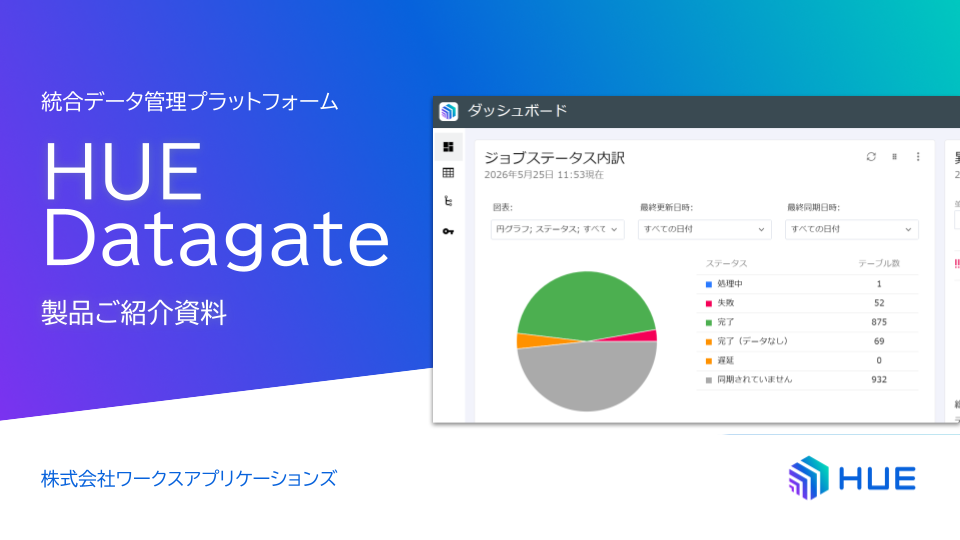
HUE Datagate Introduction
Video
2026/06/02
[Accounting Growth Engine]
How will "ESG disclosure mandates" change corporate practices?

Video
May 26, 2026
WorksWay 2026 Trinity Renewal
7/28[TUE]

Related Case Studies
Nankai Electric Railway x WAP talks about the "overwhelming return generated by 'add-on zero ERP'".
Nankai Electric Railway Co.

Nankai Electric Railway introduces HUE DI and upgrades HUE, Building a Management Foundation that Continues to Adapt to Change
Nankai Electric Railway Co.
HUE" reduces the man-hours required to prepare for inventory significantly. HUE" reduces it to a few hours.
Huis Ten Bosch Corporation